24 May 2024 · 9 min de lecture
Everything about MACH architecture: Microservices, API and Cloud
MACH, Microservices, API-first, Cloud-native, Headless, is reshaping how enterprise software gets built. Xbit explains its origins, principles and benefits.
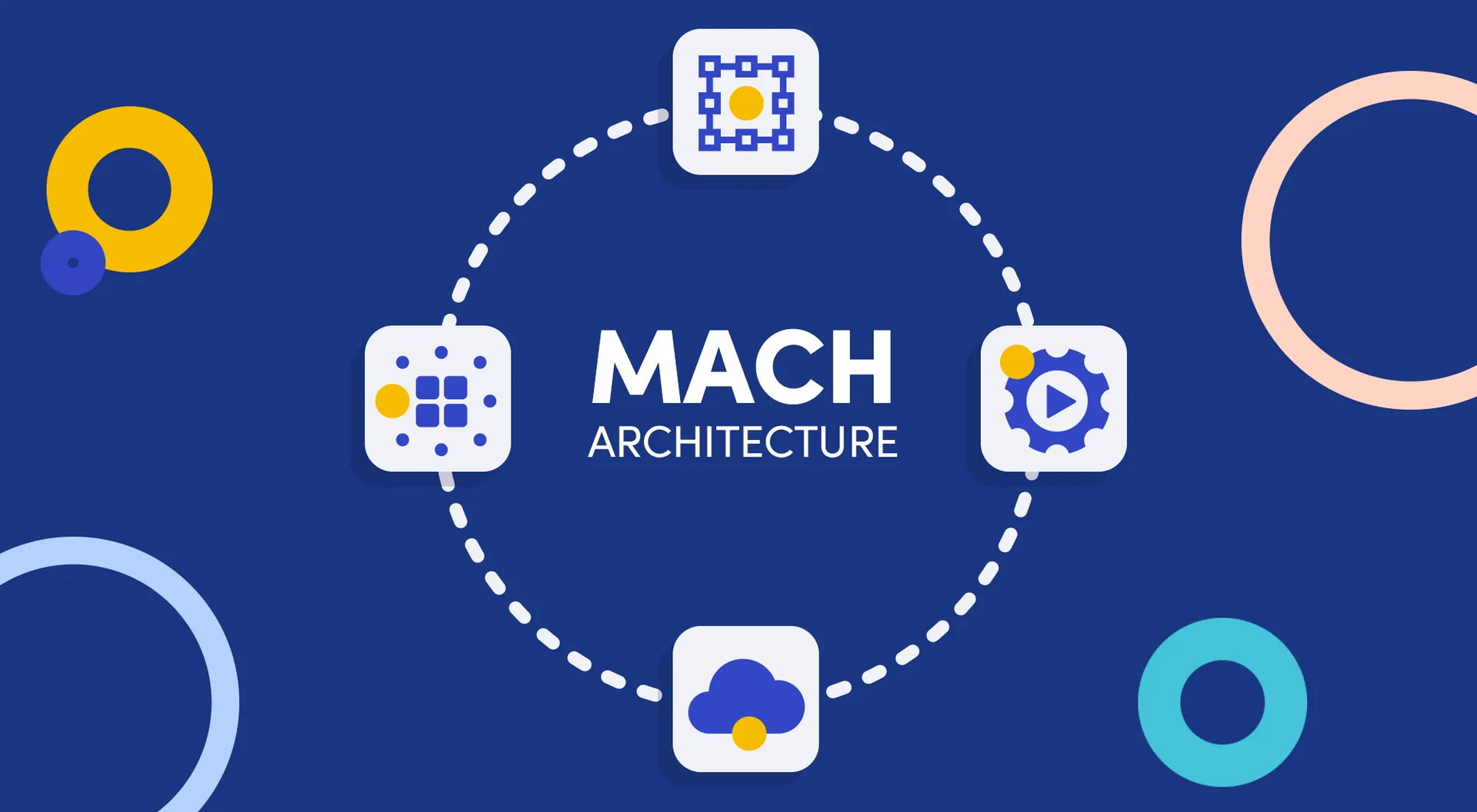
MACH architecture is revolutionising the way companies develop, distribute and maintain software. It offers numerous advantages, including scalability, flexibility, excellent performance, greater reliability, a better customer experience and a shorter time to market. Thanks to the MACH approach, companies can pick the best tools available, while keeping a structure that makes it easy to add, change or remove those tools in future.
This article defines the MACH approach, explains its origins and principles, and weighs up its advantages and drawbacks. It also gives examples and use cases for MACH architecture. Finally, we compare it with traditional architecture and assess MACH technologies in the light of Xbit's expertise in end-to-end product delivery and enterprise application development.
What is MACH architecture?
MACH is an acronym for Microservices, API-first, Cloud-native and Headless. It refers to a set of concepts and patterns that specify the building blocks of a fresh, pluggable and scalable architecture for building back-end services and cutting-edge user experiences.
A microservices solution aligned with MACH architecture is made up of distinct parts that interact directly with one another through simple APIs. Each service performs a specific function designed around a particular business capability.
The origins of MACH: how it all began
MACH emerged when e-commerce companies realised their monolithic systems could no longer keep up with growing digital customer demands. In particular, businesses had to contend with tighter data-protection limits, rising UX expectations, the need for faster and more effective marketing campaigns, omnichannel sales, and much more. A new strategy for developing IT systems duly became necessary.
The challenges posed by legacy monolithic systems
Companies often have to deal with the challenges posed by monolithic systems because of the technical debt built up by outdated technology. Since every component of an existing monolithic system is tightly coupled to the others, moving to modern JS frameworks that improve web performance used to be a risky undertaking.
Changing the user interface and adding features built around the user experience took a great deal of work. Monolithic systems take a long time to update, and because tightly interconnected systems risked collapsing altogether, managers tended to steer clear of them.
The MACH Alliance
Companies began looking for strategies that were more flexible, customer-centric, agile and future-proof. That's where the MACH approach came in. In 2020, Contentstack, EPAM Systems and Valtech founded the MACH Alliance, a non-profit organisation that gives e-commerce companies invaluable knowledge and insight into contemporary technologies and their impact on the customer experience.
Defining the MACH principles
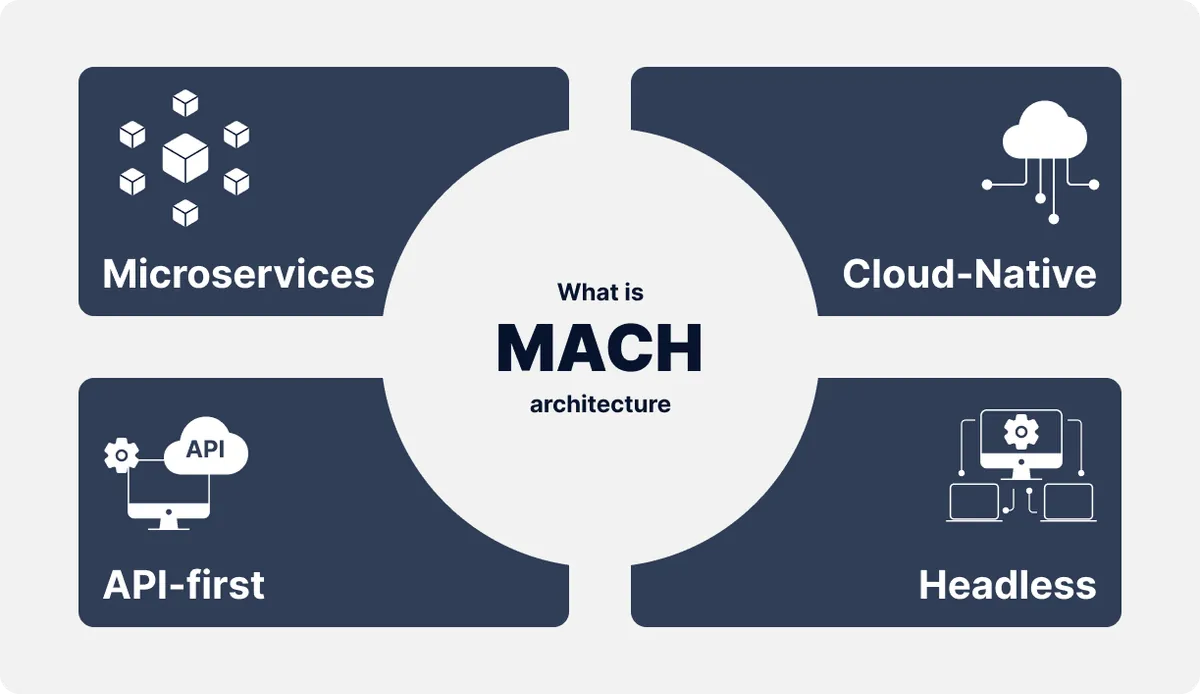
The MACH principles are centred on composability, letting you shape your entire IT ecosystem to match specific business objectives. Let's now look at each component separately to weigh up the pros and cons of this approach.
M – Microservices
Microservices, a 'cloud-native' architectural pattern, organise an application as a group of services built around specific business or technical capabilities. Typically, a small in-house development team works independently to build, test and deploy each capability.
Similarly, independent companies offering SaaS solutions can hold microservices as a self-contained system (SCS). Developers then connect them to an existing business solution. The various microservices that make up a solution are loosely coupled and loosely linked to one another, so changes made to one service need not affect the rest of the system.
A company or developer is not tied to any particular vendor or technology, since the services of a loosely coupled system can be swapped out for other internal or external implementations offering the same services and capabilities.
The single-responsibility principle, a guiding rule of software development, holds that each service in a system should own just one business or technical concern. Adopting a microservices architecture brings many other benefits too: development teams can ship large-scale applications quickly and repeatedly, while businesses get best-in-class SaaS solutions without being tied to a single vendor.
A – API-first
The 'API-first' approach lets two or more systems interact. Here, APIs are 'first-class citizens': in other words, the entities that support every function are generally made available to other entities. They expose all of a business's functionality through a clear set of contracts, and those contracts are the entry point for every service-related business activity. API-first is therefore closely tied to microservices.
These contracts usually follow API description languages such as OpenAPI, which support solid design and communication between technical and non-technical stakeholders alike. With this method, businesses build APIs for every device and platform, supporting all kinds of applications in a multichannel environment.
C – Cloud-native SaaS
Cloud-native is a cutting-edge approach to building, designing and running software applications that make full use of the cloud. This paradigm draws on a range of contemporary software development techniques, including agile methodologies, DevOps, continuous integration and delivery, microservices and containers, resulting in applications that are adaptable, scalable and robust.
H – Headless
Headless systems are API-first services that support building applications with a completely separate user interface and back end. Headless systems make their content available through RESTful or GraphQL APIs, which you can use to power different services instead of shipping a conventional user interface (presentation layer).
Defining the MACH principles
MACH brings together several development patterns from across the software industry. As 'cloud-first' takes off, digital applications are becoming increasingly modular, and this is where headless patterns help with customisation. Let's now weigh up the main advantages and drawbacks of MACH architecture.
What are the benefits of MACH architecture for businesses?
Here are the most compelling benefits a business can get from MACH architecture.
Scalability
Scalable software architecture is one of the core goals of MACH. Its streamlined adaptability is one of the biggest advantages for organisations whose needs keep changing. For example, you can scale MACH technologies to handle increased load as your business grows.
Composability and flexibility
MACH architecture is also highly flexible, making it easy to adapt using the best available solutions to meet a business's unique requirements. Thanks to their adaptability, MACH solutions are ideal for companies that need to respond quickly to changes in their external environment. The MACH technology stack offers a wide range of scalable, adaptable enterprise technologies, making it a preferred option for many businesses.
Future-proof technologies
As the world goes digital, the need for faster, more efficient data and content processing keeps growing. Technologies within the MACH ecosystem answer that need by offering a scalable, adaptable architecture suited to ever-changing requirements.
The MACH technology stack is also future-proof, so businesses can keep using it for many years without it becoming outdated. Its modular design lets new components be added as needed, meaning that with MACH-first software, businesses can be confident their investment will pay off over the long term.
Faster time to market
With microservices-based MACH architecture, businesses build and deploy applications faster. MACH cuts the time needed to bring new features and capabilities to market by breaking applications down into discrete, independent services that can be built and delivered autonomously.
Because MACH services are loosely connected, they are also easier to change and update. This reduces the risk of errors and makes it easier to roll out new features and capabilities quickly and efficiently. As a result, MACH enables faster time to market, greater agility and better overall software quality.
Monolithic architecture versus MACH architecture
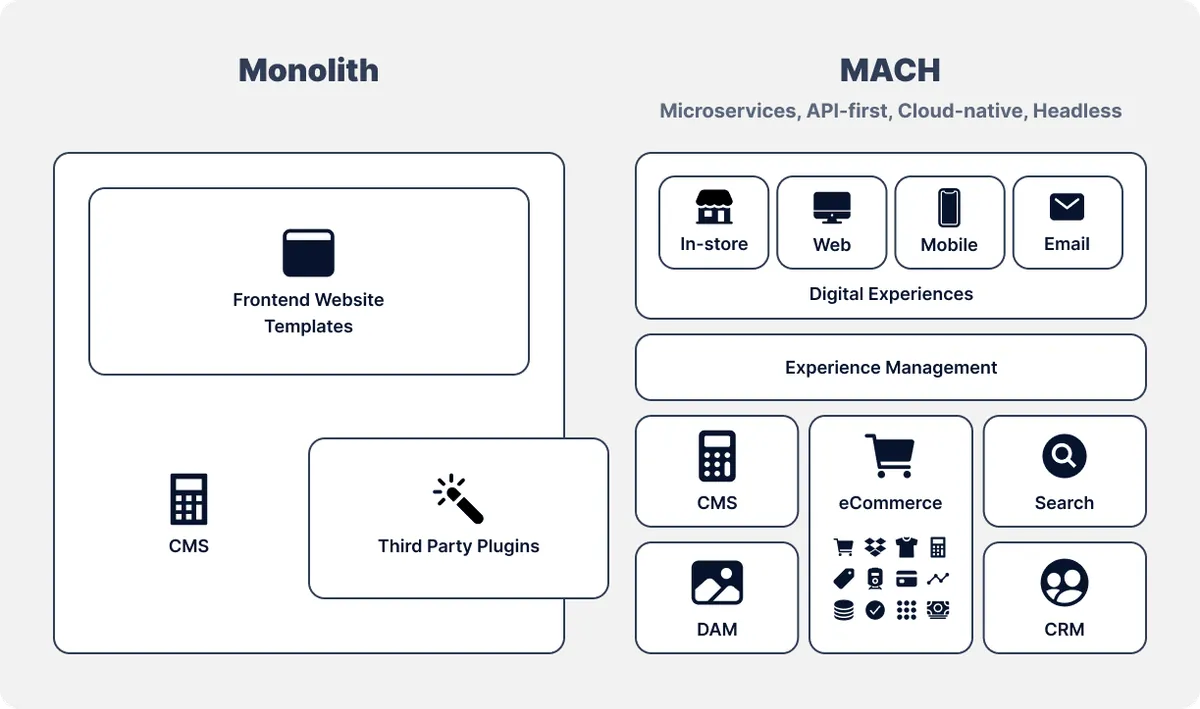
Digital experience platforms help shape, manage and organise customer expectations. Monolithic architectures, on the other hand, have significant shortcomings when it comes to adapting to changing business needs.
The trouble is that most monolithic architectures lack the flexibility and functionality to keep up with businesses' growing feature requirements. As a result, companies looking to get the most out of their digital experience investments should consider MACH architecture.
Monolithic architecture versus MACH architecture
MACH architecture offers many advantages that make it a desirable choice for businesses. Arguably the most important is its scalability: a company can add new applications seamlessly without having to reconfigure the entire system. As a result, businesses can tailor deployment to their needs thanks to a highly flexible design.
Businesses need to weigh up their specific requirements and needs when evaluating MACH architecture. To assess a potential MACH tool, start by answering the following questions:
- Can you add and replace services incrementally?
- Can you add or replace systems and services independently of one another?
- Does the platform use APIs from the outset, or did you bolt one on later?
- Is technical documentation on the platform's resources and capabilities easy to access?
- Is cloud infrastructure scalability unlimited?
- Do continuous-delivery updates and upgrades roll out without major issues?
- Can you design and implement the user experience freely and flexibly?
With MACH architecture, businesses strengthen their digital capabilities and move forward. It can therefore benefit any organisation striving to stay ahead of emerging trends.